One AI employee vs. your $2k/mo marketing stack
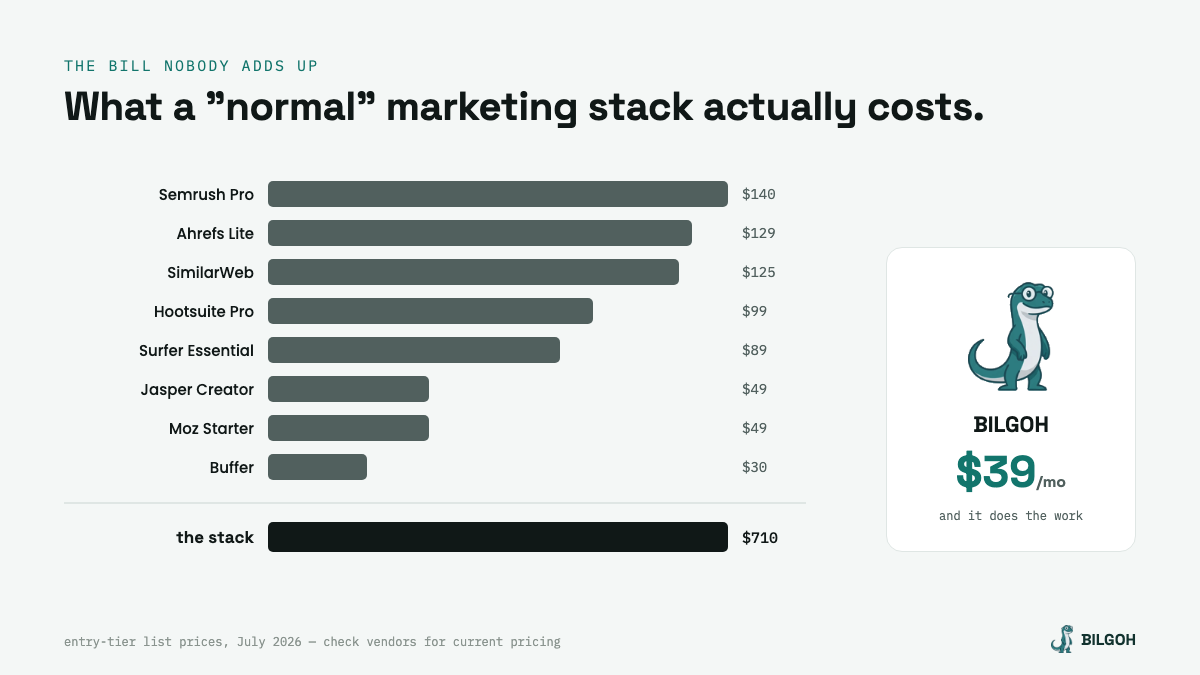
Do this exercise once and it will annoy you forever: open your card statement and add up everything that bills monthly with a marketing logo on it. Not the big obvious one — all of them. The SEO suite you check twice a month. The backlink tool you got for one audit and never cancelled. The social scheduler, the copy assistant, the competitor-intel thing from that trial.
For a typical small SaaS team, the tool subtotal alone lands somewhere between $500 and $800 a month at entry-tier list prices. Semrush Pro is around $140. Ahrefs Lite, $129. SimilarWeb, Hootsuite, Surfer, Jasper, Moz, Buffer — each reasonable alone, absurd in aggregate. And that's before the part everyone forgets.
The stack doesn't include the operator
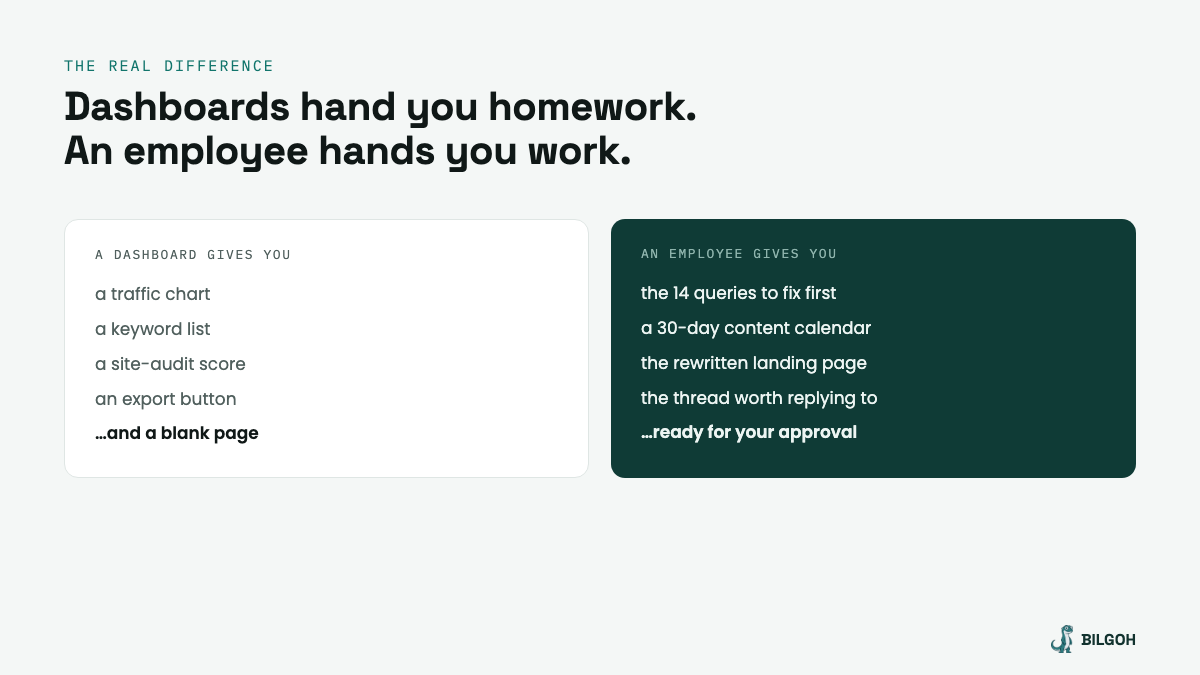
Tools don't do marketing. They produce inputs to marketing: a keyword list, an audit score, a traffic chart. Someone still has to turn those inputs into finished work — the rewritten landing page, the published article, the posted reply. If that someone is a freelancer at even a modest rate, add $1,000–1,500 a month for part-time execution. If it's you, add the hours you weren't building product.
That's how a "$140/mo Semrush subscription" quietly becomes a $2,000/mo marketing function that still feels understaffed. The dashboards were never the expensive part. The hands were.
What "employee" actually means here
"AI employee" gets thrown around loosely, so here's the definition we hold ourselves to — the four things that separate an employee from a tool with a chat box:
- It reads your real data. Not estimates, not a generic industry model. It connects to your Search Console and Analytics, your backlink profile, how AI models describe your product — and works from those numbers.
- It holds context between tasks. A tool forgets you the moment you close the tab. An employee remembers your positioning, your customers, your voice, and everything it already shipped — so the fortieth deliverable is as on-brief as the first.
- It ships deliverables, not dashboards. The output is the actual work: the content calendar, the audit with fixes ranked, the drafted reply, the rewritten page. Reviewed by you, done by it.
- It learns from results. What ranked, what converted, what flopped — the outcomes feed back into how it plans the next month.
Measured against that definition, most of the stack isn't even trying. Semrush is a superb instrument. It will never write the article.
The honest comparison table
| What you need | The stack way | The employee way |
|---|---|---|
| Know where you rank | SEO suite, ~$140/mo | Included — live from GSC |
| Backlink picture | Backlink tool, ~$129/mo | Included |
| A month of content, planned | Content tool + your weekend | Drafted for approval |
| Somewhere to post today | Scrolling Reddit at lunch | Scored threads, reply drafted |
| Someone to actually do it | Freelancer, $1,000+/mo | That's the point |
| Monthly total | ~$2,000 | $39 |
Where the human stays in the loop — permanently
Now the part a pricing page won't tell you, but we will. An AI employee does not replace your judgment, and you shouldn't want it to. Three things stay yours:
Approval. Nothing worth shipping should ship unreviewed. Bilgoh queues every deliverable for your sign-off — that's a feature, not a limitation. You're the editor-in-chief of a very fast department.
Taste and strategy. Whether the brand should sound playful or premium, whether to chase enterprise or stay self-serve — an employee executes strategy brilliantly and sets it poorly. Same as a human junior hire, honestly.
The final send. Bilgoh writes your cold email sequence; it doesn't send it. It finds the Reddit thread and drafts the reply; you post it under your name. Anything that touches another human directly keeps a human behind it.
If a vendor tells you their AI needs none of this, either they're wrong or their bar is lower than yours.
Bilgoh is the employee in this comparison: one hire at $39/mo that covers the work of the search suite, the backlink tool, the content assistant and the social listener — connected to your real numbers, running eight specialist crews, with you in the approval seat. The free tier exists so you can check the math on your own workspace before paying anything.
Run your own numbers
Don't take a vendor's word for it — including ours. The audit takes ten minutes: list your marketing subscriptions and their real monthly cost, add what you pay humans (or yourself, in hours) to operate them, then ask of every line item: does this produce work, or homework? Cancel what only produces homework, or hand its job to something that finishes it.
Start with the search picture — it's where trapped value hides. Our post on striking-distance keywords shows the exact report to run first, with or without us.
One employee. On payroll for $39.
Connect your data, give it a goal, and review what it ships. Free tier first — check the math yourself.
Start free →