Where to actually post: turning Reddit and HN into signups
Every founder tries community marketing once. It usually goes like this: you ship something, you're proud of it, you paste a link into three subreddits, and within an hour you've collected two removals, one mod warning, and a comment that just says "ad." You conclude Reddit doesn't work and go back to whatever you were doing.
Reddit works fine. Hacker News works fine. What doesn't work is treating them like distribution channels, because they're not — they're rooms full of people having conversations, and some tiny fraction of those conversations happen to be about the exact problem you solve. Community marketing is the craft of finding those conversations and being genuinely useful in them. Everything else is spam with extra steps.
The unit of value is one thread
Here's the mental shift that changes results: stop thinking in posts-per-week and start thinking in threads-found. One well-chosen thread where a person with an actual budget asks the question your product answers — and where you show up early with a real answer — is worth more than fifty drive-by comments. We've had single Reddit replies outperform a month of scheduled social posts. Not because the reply was brilliant, but because the thread was right.
The problem is that finding the right thread is miserable manual work. The good ones are perishable — a question posted six hours ago is warm, a question from last Tuesday is compost — so "checking Reddit" becomes a daily chore you do badly or skip. That's the part worth systematizing.
What a thread worth answering looks like
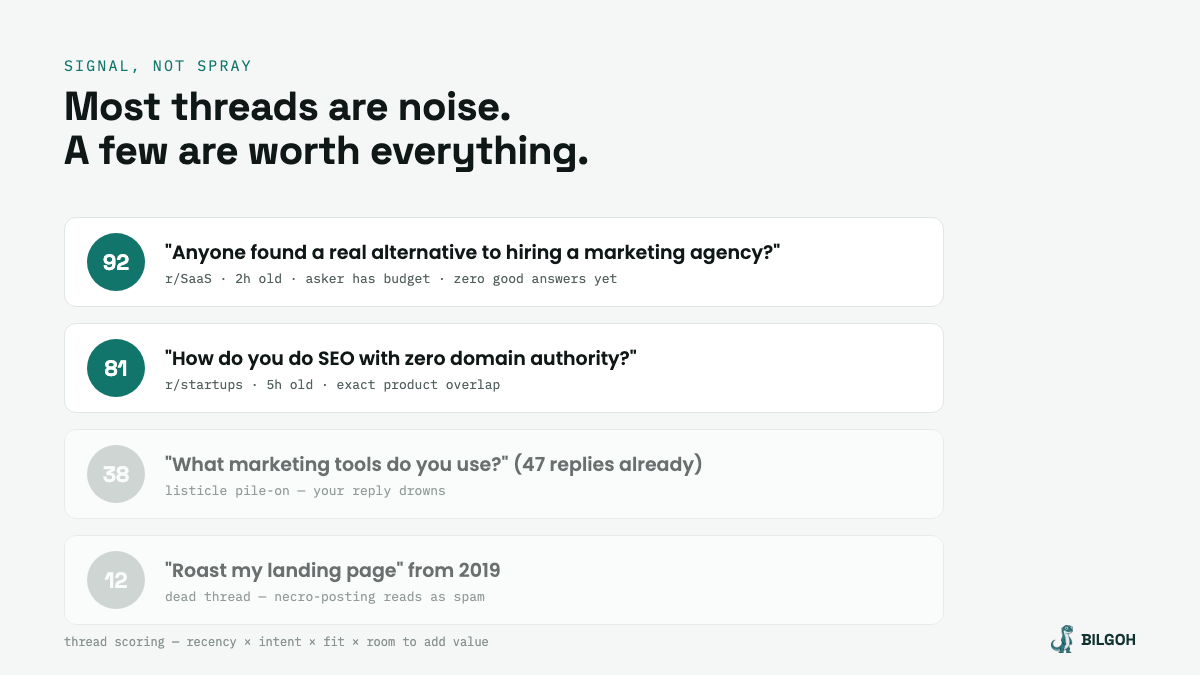
After enough repetition you can score a thread in about five seconds. Make the criteria explicit and it stops being instinct and becomes a checklist:
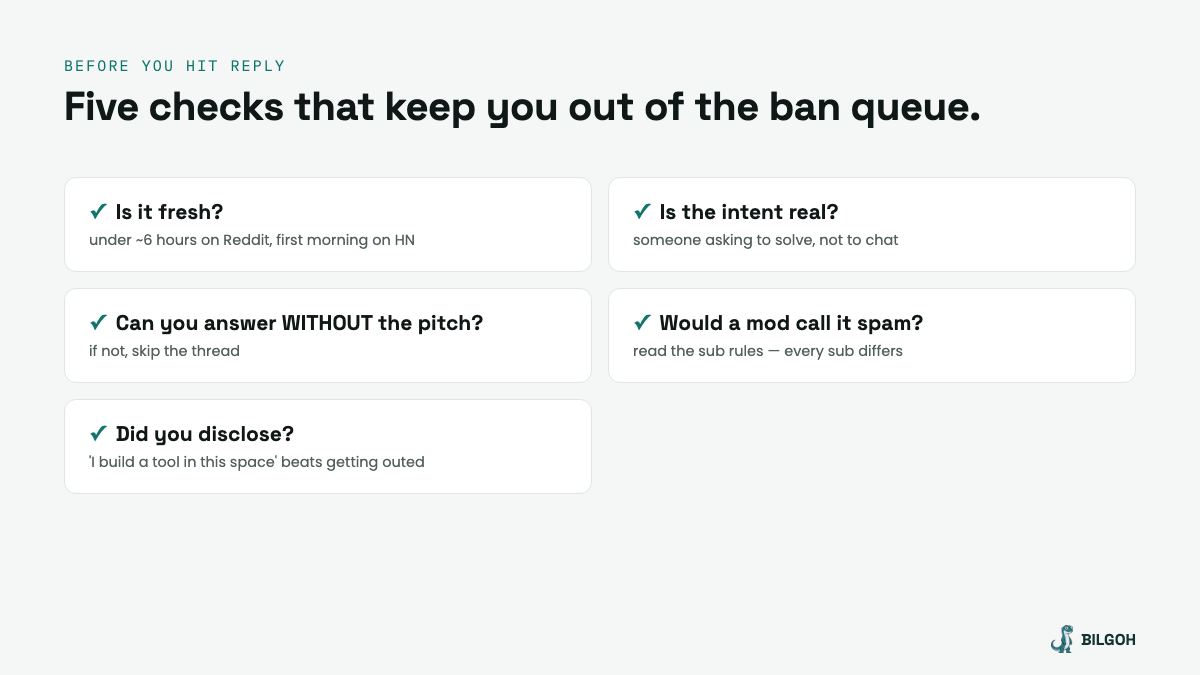
- Fresh. On Reddit, under six hours old is ideal — you want to be one of the first substantive answers, not comment #48. On HN, the front-page window is what matters, and it's brutal: a few hours, usually in the US morning.
- Real intent. "Anyone found a real alternative to hiring a marketing agency?" is someone trying to solve a problem this quarter. "What tools does everyone use?" is a listicle party where every vendor names themselves and nobody reads reply #30.
- Genuine overlap. The thread's problem and your product's answer need to actually match. Close-enough is how you end up in the removed queue. If you have to squint, skip it.
- Room to add value. If three excellent answers already exist, you're late. The best threads have engagement (upvotes, a few weak comments) but no good answer yet.
- A culture you've read. Every subreddit has its own rules about self-promotion — some ban it outright, some allow it with disclosure. Read the sidebar. One removal is an accident; two is a pattern mods remember.
The reply that doesn't get you banned
The structure that works is boring and honest:
Answer the question first, completely, as if your product didn't exist. This is the whole trick. If you can't write three useful paragraphs without mentioning yourself, you don't belong in the thread. The answer is what earns the right to the next part.
Disclose, then mention — briefly. "Full disclosure, I build a tool in this space" reads as confident. Getting outed by a commenter who checked your profile reads as sleazy, and it torches the useful answer above it. One sentence about your product, framed as one option among several, is the ceiling. Naming a competitor alongside yourself paradoxically increases clicks — it signals you're recommending, not selling.
Then leave. Don't defend, don't follow up with links, don't reply to every comment. The thread isn't yours.
The test we use before posting: if a mod DM'd us asking "why is this comment here?", would the honest answer be "because it helps the asker" or "because it links to us"? If it's the second, delete it.
Hacker News is its own animal
Everything above applies double on HN, plus two specifics. First, "Show HN" is the sanctioned front door — use it for launches, follow the format, and expect the most useful hostile feedback of your life. Second, in regular threads, HN's tolerance for self-promotion is roughly one parenthetical per year, so spend it well. A deeply technical comment that happens to end with "(I work on this problem at X)" can do more for a dev-adjacent product than any ad budget. A shallow one gets flagged into oblivion.
Make finding threads someone's job — just not yours
The checklist is easy. The discipline of running it every morning across Reddit, HN, and the long tail of Medium posts and niche forums is not. This is exactly the kind of work that should be automated: wide, repetitive scanning with a clear scoring rule, where a human only needs to see the top three results.
Bilgoh's Social Radar runs this system live. It scans Reddit, Hacker News and Medium for conversations that match your product context, scores each thread 0–100 on the criteria above (freshness, intent, fit, room to add value), dedupes what you've already seen, and hands you the thread, the reason it fits, and a drafted reply in your voice. You review, edit, and post it yourself — the judgment stays human, the hunting doesn't. See it scoring live threads →
What to expect, honestly
Community marketing is a slow compounding channel, not a spike machine. A good month for an early-stage product might be six or eight genuinely useful replies. What you get back: a handful of signups that convert unusually well (they arrived pre-sold by context), search visibility as threads rank for your keywords, and — quietly the most valuable part — a running feed of how real people phrase the problem you solve. That phrasing belongs in your landing pages, your titles, and your striking-distance keyword fixes.
Spray less. Snipe more. And let something else do the scanning.
The thread worth answering is live right now.
Bilgoh's Social Radar finds it, scores it, and drafts the reply — you stay the voice.
Start free →